
Last updated October 30, 2026
 Home additions & ADU
 Kitchen remodeling
 Bathroom remodeling
 Roofing
 Windows & doors
 Driveway & pavers
 Fence
Free written scope consultation - allowances, timeline, and change-order rules on paper before a single trade is scheduled
Construction Emergency Preparedness Guide for Saratoga Homes
When the SCU Lightning Complex fire pushed toward Saratoga’s hillside neighborhoods in 2020, most homeowners had go-bags and evacuation routes ready. What they didn’t have was documentation of their roof’s condition, a record of their retaining wall’s last inspection, or any relationship with a contractor who could respond the week after the smoke cleared. And that’s where the real financial damage happened. This guide covers the construction-layer emergencies Saratoga homeowners actually face, how to prepare for them before they happen, and what separates a legitimate emergency response from a storm-chasing contractor who shows up at your door with a clipboard and a sense of urgency.
Quick Answer
Construction emergency preparedness for Saratoga homes means documenting your property’s structural condition before disaster hits, understanding which failures are most likely given our specific hillside terrain and storm patterns, and knowing exactly who to call when a roof fails, a retaining wall shifts, or storm water finds its way into your foundation. A prepared homeowner has three things: a pre-emergency photo and document file, a short list of vetted contractors who already know the property, and a clear understanding of which failures require immediate professional response versus which can wait for daylight.
Styles & brands we work with
Table of Contents
- The Construction Emergencies Most Likely to Hit Saratoga Homes
- Pre-Emergency Documentation: What to Record Before You Need It
- Legitimate Emergency Response vs. Storm-Chaser Contractors
- Cal OES, Santa Clara County Registries, and Why Your GC Relationship Matters More
- Hillside-Specific Warning Signs: Slope Instability and Retaining Wall Failure
- Storm Drain Backup and Foundation Water Intrusion: The Silent Emergency
- Roof Failure During Atmospheric River Events: What Actually Happens
- Your 72-Hour Emergency Response Plan
The Construction Emergencies Most Likely to Hit Saratoga Homes
Saratoga sits against the Santa Cruz Mountains, which means our emergency profile looks nothing like a flat suburban tract home in Sunnyvale or Campbell. We deal with gravity, drainage, and wind loads that most Bay Area homes never see. After fifteen years of responding to post-storm and post-fire damage in Saratoga, our team has seen the same three emergencies repeat with statistical regularity.
Roof failure during atmospheric rivers is the most common. Saratoga’s winter storms push sustained wind against west-facing roof pitches while dumping several inches of rain in a single event. Shingles that looked fine in August give way in January. Flashing around chimneys and skylights separates. The result isn’t usually a dramatic hole in the roof. It’s a slow leak that runs along the sheathing, follows a rafter, and shows up as a water stain on a ceiling three days after the storm has passed. By then, the damage has spread through the insulation and into the drywall.
Retaining wall movement on hillside parcels is second. Saratoga’s hillside homes rely on engineered retaining walls to hold back slopes that can exceed 30 degrees. These walls are built to withstand normal seasonal moisture cycles, but a prolonged wet winter saturates the soil behind them, increasing lateral pressure beyond the design load. The first sign is usually a crack in the wall that wasn’t there before. The second sign is a tilt you can measure with a level. By the time the wall actually fails, you’re looking at a five-figure reconstruction, not a repair.
Storm drain backup causing foundation intrusion rounds out the top three. Saratoga’s older neighborhoods, particularly those built in the 1960s and 1970s, have storm drain systems that weren’t designed for the rainfall intensity we now see. When drains back up, water pools against foundation walls, finds its way through cracks or utility penetrations, and begins undermining the structure from below. This emergency is the most insidious because it happens slowly, often over days, and many homeowners don’t recognize it until the musty smell becomes impossible to ignore.
Pre-Emergency Documentation: What to Record Before You Need It
The single most valuable thing a Saratoga homeowner can do for their insurance claim and their sanity is to document the home’s construction condition before anything goes wrong. Insurance companies adjudicate claims based on evidence. If you can’t prove your roof was intact before the storm, the adjuster has room to argue that the damage was pre-existing or the result of deferred maintenance.
Here’s exactly what to document, organized by priority:
- Roof condition photographs. Take photos of the entire roof surface from multiple angles, close-ups of flashing around chimneys, vents, and skylights, and gutters. Do this once a year, stored with a date stamp. After a storm, take the same photos again. Side-by-side comparison is your strongest claim evidence.
- Retaining walls and slopes. Photograph every retaining wall on the property from a fixed reference point. Use a level on the top of the wall and photograph the bubble. If the wall is already leaning, measure the lean and record it. This creates a baseline that proves whether movement happened during a specific weather event or existed beforehand.
- Foundation inspection records. If you’ve ever had a foundation inspection, keep the report. If you haven’t, now is the time. A pre-emergency inspection establishes a baseline for cracks, moisture levels, and structural condition.
- Permit history file. Pull your home’s permit history from the City of Saratoga building department. Keep it in a file with your insurance policy. If a previous owner did unpermitted work, you need to know about it before a claim gets complicated.
- Material and spec records. If you’ve remodeled, keep the specs: what type of roofing material was installed, what brand of windows, what waterproofing membrane under the tile. When your General Contractor in Saratoga completes work, ask for a material spec sheet. It matters for claims and for matching repairs.
- Drainage system map. Know where your downspouts discharge, where your storm drain runs, and where the cleanouts are. In an emergency, this is the difference between a quick fix and a flooded basement.
Store all of this in the cloud, not just on a home computer. If the home is damaged by fire or flooding, local storage may be destroyed along with everything else.
Legitimate Emergency Response vs. Storm-Chaser Contractors
After every major storm that hits Saratoga, the same thing happens. Within 48 hours, trucks with out-of-state plates start circulating through hillside neighborhoods. They knock on doors, leave flyers, and offer “free emergency inspections” for roof damage. Some of them are legitimate. Many of them are not.
A storm-chaser contractor follows a specific pattern. They show up unsolicited, often before you’ve filed a claim. They claim to have “inspected your roof from the street” and found damage. They pressure you to sign an assignment of benefits, which transfers your insurance claim rights to them. Once signed, they control the claim, they name their own price, and if the work is shoddy, you have no leverage because the contract is with your insurer, not with you.
Here’s what a legitimate emergency response looks like:
- They provide a written, line-item scope of work before any contract is signed.
- They encourage you to file your own insurance claim and work with your adjuster.
- They pull permits when permits are required by the City of Saratoga.
- They have a physical office, a contractor license you can verify on the CSLB website, and references within Saratoga or neighboring communities.
- They tarp and stabilize first, then discuss permanent repairs. A legitimate contractor’s priority is preventing further damage, not locking in a contract while you’re panicked.
- They never ask you to sign an assignment of benefits as a condition of starting emergency work.
The distinction matters because emergency tarping and water mitigation are the exact scenarios where homeowners get taken. You’re stressed, it’s raining into your living room, and someone is telling you they can make it stop if you just sign. A pre-existing relationship with a contractor who knows your home eliminates this vulnerability entirely. That contractor already knows what your roof looks like, what your drainage does, and what your home’s history is. They don’t need to create urgency. They just need to respond.
Cal OES, Santa Clara County Registries, and Why Your GC Relationship Matters More
California maintains emergency contractor registries through Cal OES and local county programs. The Santa Clara County Office of Emergency Management keeps a list of contractors who have pre-registered to provide emergency services during declared disasters. These registries serve a specific purpose: they help match homeowners with available contractors when local capacity is overwhelmed.
Here’s what the registry actually covers: during a declared emergency, registered contractors can perform emergency protective measures, like tarping, board-up, and temporary shoring, without waiting for normal permit review. The registry doesn’t vet quality. It doesn’t guarantee pricing fairness. It doesn’t establish any relationship between you and the contractor. It’s simply a mechanism for getting someone on-site when the normal process would take too long.
That’s why an existing relationship with a general contractor is more reliable than any registry. When you’ve already worked with a contractor on a Home Remodeling in Saratoga, that contractor has:
- Institutional knowledge of your home’s systems, materials, and history.
- A financial incentive to protect your relationship, not just extract value from a single emergency.
- Established trust with local building officials in the City of Saratoga.
- Access to the same 50+ brand relationships they use on regular projects, including roofing systems from GAF, CertainTeed, and Owens Corning, which means emergency repairs match existing materials instead of whatever is available at the nearest supply house.
If you don’t yet have that relationship, now is the time to establish one. A pre-emergency inspection is inexpensive relative to the cost of a botched emergency repair, and it gives you a baseline assessment from someone who has walked your property and understood its vulnerabilities. Even a basic Home Renovation in Saratoga consultation creates a paper trail and a point of contact that didn’t exist before.
Hillside-Specific Warning Signs: Slope Instability and Retaining Wall Failure
Saratoga’s hillside parcels fail differently than flat lots. The warning signs are specific, measurable, and often ignored because they develop gradually. A hillside home that was fine five years ago can become structurally compromised through a combination of soil saturation, drainage failure, and deferred maintenance, and the homeowner often doesn’t recognize the signs until a wall has visibly moved.
Here are the symptoms that require immediate geotechnical assessment, in the order you should address them:
- Soil cracking near the top of a slope. Crescent-shaped cracks in the soil above a retaining wall or on a natural slope indicate that the soil mass is beginning to move. This is the earliest warning sign and the most commonly missed. If you see these cracks, document them with photos from a fixed reference point and call a geotechnical engineer.
- Retaining wall lean that’s measurable. Use a level on the face of the wall. If the bubble is off center, measure the lean. More than one inch of lean per ten feet of wall height is worth a professional assessment. A wall that’s leaning two inches per ten feet is actively failing. Document the lean monthly, and if it increases, act immediately.
- Door frame racking. If interior doors that used to close properly now stick or won’t latch, the door frames are out of square, which means the structure itself is shifting. This isn’t a humidity issue. It’s a foundation or slope movement issue.
- New cracks in the foundation or slab. Hairline cracks are normal in Saratoga’s clay soils. Cracks wider than a quarter-inch, or cracks that change width seasonally, are not. Document and monitor. If the crack is wide enough to fit a coin edge, get a professional opinion.
- Drainage changes after heavy rain. If water flows differently across your property after a storm than it did before, soil has shifted somewhere. This could mean a blocked drainage path, a failed pipe, or slope movement. All three need attention.
The sequence of who to call matters. For slope instability, the first call is a geotechnical engineer who can assess the soil and wall condition and write a report. The second call is your general contractor, who can execute the recommended remediation. The third call is your insurance company, who will want the engineer’s report and contractor’s scope before approving any claim. Trying to reverse that order wastes time and compromises your claim.
Storm Drain Backup and Foundation Water Intrusion: The Silent Emergency
Foundation water intrusion doesn’t announce itself with a crash. It starts with a slight musty smell in a room that shares a wall with the outside. Then a dark spot appears on the baseboard. Then the drywall begins to crumble at the bottom edge. By the time you can see the damage, water has been moving through the foundation for weeks or months, and the repair scope has grown from a simple drain cleanout to a full foundation waterproofing project.
Saratoga’s older storm drain systems are the usual culprit. Homes built before the 1980s often have clay drain pipes that crack over time, or drain systems that were sized for rainfall patterns that no longer match what we receive. When a storm drain backs up, water that should be carried away from the home pools against the foundation instead. From there, it enters through three paths: cracks in the concrete, gaps around utility penetrations, and capillary action through the slab itself.
Prevention is the right strategy here, and it’s less expensive than repair. Before the rainy season:
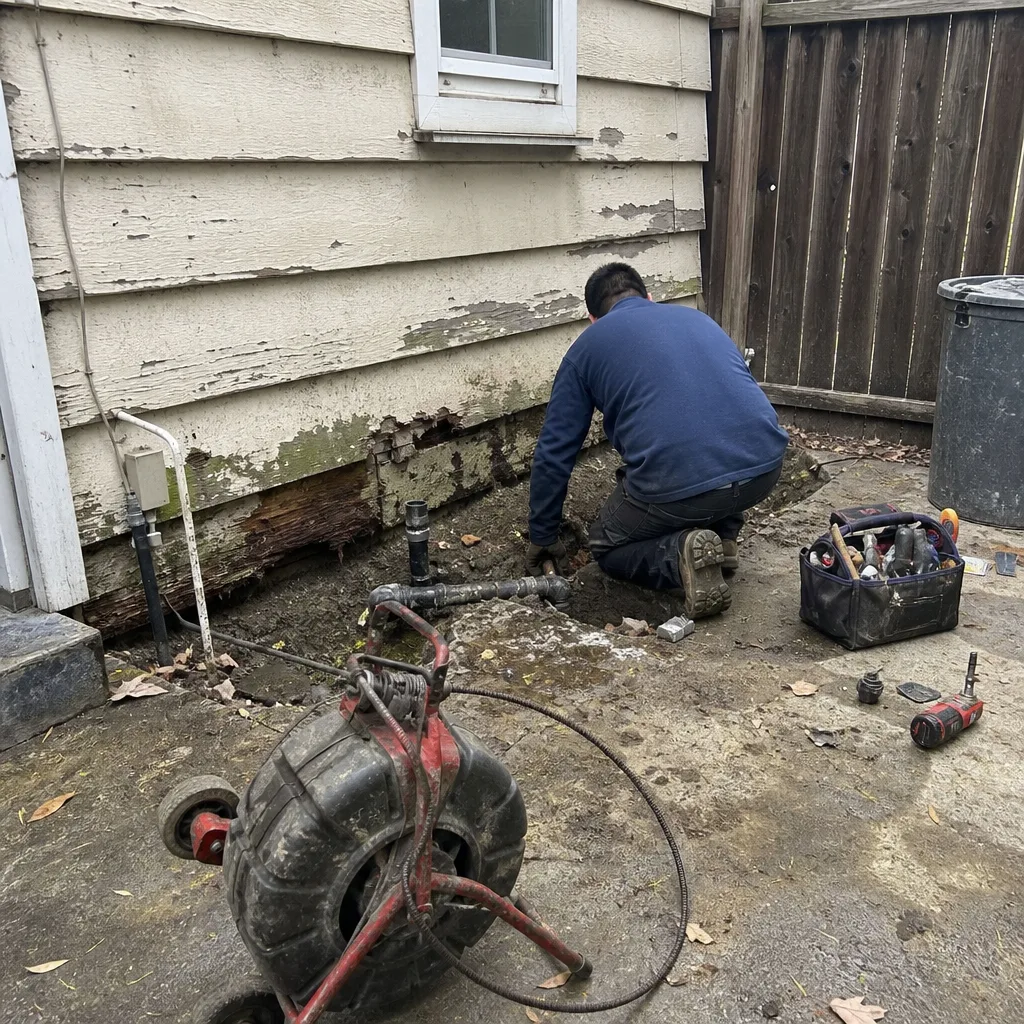
- Have a plumber camera your storm drain and sanitary sewer lines. This identifies cracks, root intrusion, and collapsed sections before they cause a backup.
- Check all downspouts and make sure they discharge at least four feet from the foundation. Saratoga hillside homes often have downspouts that dump water against the uphill side, which is exactly where it shouldn’t go.
- Verify that your sump pump, if you have one, is operational and has a battery backup. Neighborhoods in the Saratoga foothills lose power during storms with regularity.
- Install water sensors in basements, crawl spaces, and any room with a slab-on-grade floor. These are inexpensive, and they alert you before a leak becomes a flood.
If you already have signs of intrusion, don’t wait. Water that’s been moving through a foundation system is actively degrading the concrete and any wood framing it touches. What starts as a $500 drain scope becomes a $15,000 waterproofing and remediation project when the damage spreads.
Roof Failure During Atmospheric River Events: What Actually Happens
Atmospheric rivers are the weather events that cause the most roof damage in Saratoga. These are concentrated bands of moisture that can dump five to ten inches of rain over two or three days, often accompanied by sustained winds of 20 to 40 miles per hour. For a roof that’s five years old or less with proper installation, this is usually fine. For a roof that’s ten years old with signs of wear, or a roof that was installed incorrectly in the first place, it’s a failure waiting for the right storm.
The failure sequence is almost always the same. Wind catches a loose shingle or tile and lifts it. Rain enters through the gap. The water runs along the underlayment, which may be compromised if it’s old, and reaches the roof decking. The decking swells and softens. The next storm finds the weakness and works it wider. Within a season, what started as a single lifted shingle becomes a section of roof that’s actively leaking, with water damage in the attic and insulation.
The fix depends on the failure stage. An early-stage lift is a repair. A mid-stage leak is a section replacement. A full failure means roof replacement, and the cost jumps accordingly. GAF, CertainTeed, and Owens Corning all make excellent roofing systems, and matching the existing material matters for both appearance and warranty coverage. If your roof was installed with a CertainTeed system and an emergency repair uses a mismatched product, the warranty on the original system is void.
The best preparation for atmospheric river season is a pre-season roof inspection. A qualified inspector looks for lifted shingles, cracked flashing, failing sealant around penetrations, and gutter issues that could contribute to water intrusion. The inspection costs a few hundred dollars and identifies issues before they become emergencies. If you wait until the storm is already overhead, your options narrow to emergency tarping and hoping the damage doesn’t spread before a roofer can respond.
Your 72-Hour Emergency Response Plan
When something goes wrong at 11pm during a winter storm, the quality of your response depends entirely on work you did months before. The homeowners who manage emergencies well have a plan. The ones who don’t end up with preventable secondary damage and inflated repair costs.
Here’s a practical 72-hour response framework for any construction emergency in Saratoga:
- Hour 0-2: Stop the source. If water is entering the home, shut off the main water valve if it’s a plumbing failure. If it’s roof water, contain what you can with buckets and tarps. Move valuables and electronics. Take photos of everything before you touch anything; your insurance claim depends on documenting the damage as you found it.
- Hour 2-6: Make the emergency calls. Call your insurance company first and open a claim. Then call your general contractor. If the situation is dangerous, such as a gas smell, exposed wiring, or structural collapse, call 911 before anyone else. Turn off gas and electricity if water is near electrical panels or appliances.
- Hour 6-24: Stabilize what’s failing. This is where emergency tarping, temporary shoring, or drain clearing happens. A contractor who’s already familiar with your home can do this within hours. A contractor you’re calling cold will take longer and may not be available at all during a region-wide weather event.
- Hour 24-72: Get a written scope. Once the immediate threat is contained, ask your contractor for a written scope of work with line-item pricing. This goes to your insurance adjuster. Don’t sign any permanent repair contract until the adjuster has reviewed the scope. Emergency stabilization work is authorized separately, so don’t confuse the two.
- Hour 72 and beyond: Plan permanent repairs. This is where the real work begins. The goal is to restore the home to its pre-loss condition, not just patch the visible damage. Work with your contractor to identify what can be repaired versus what needs replacement, and get everything in writing before work starts.
We’ve used this framework with our own clients throughout Saratoga, and it works because it removes the panic from the equation. You’re not making decisions under duress. You’re following steps that were defined before the emergency happened.
Common Mistakes to Avoid
- Signing an assignment of benefits during an emergency. This transfers control of your insurance claim to a contractor you just met, and you can’t take it back. Never sign one as a condition of emergency work. It’s the single most common way Saratoga homeowners get trapped in bad contracts.
- Filing a claim without pre-emergency documentation. Your adjuster can only pay for what you can prove. Without baseline photos and records, the claim becomes a negotiation you’re not equipped to win. Document before the storm, every time.
- Ignoring retaining wall cracks because “it’s always been like that.” A crack that’s stable is one thing. A crack that’s growing is a structural problem. Measure and monitor, and get a professional assessment when the measurements change.
- Waiting until after the storm to find a contractor. After a major atmospheric river event, every qualified contractor in Saratoga is booked for weeks. If you don’t have a pre-existing relationship, you’ll be working with whoever is available, not whoever is best.
- Assuming the insurance company will handle everything. Insurance companies process claims. They don’t manage your repair. You need a contractor who understands the claim process, can write a proper scope, and will advocate on your behalf when the adjuster’s numbers are too low.
- Delaying roof replacement because it’s not leaking yet. A roof that’s past its service life is a time bomb. Saratoga’s storm seasons expose deferred maintenance. Replace it on your schedule, not the storm’s schedule.
See the difference
 Before
 After
 Before
 After
 Before
 After
When to Call a Professional
Some emergencies are obvious: water pouring through the ceiling, a retaining wall visibly leaning, a foundation crack that’s opened wide enough to see daylight through. Those all warrant an immediate call. But the subtler situations are where homeowners talk themselves out of calling, and that’s exactly where the expensive damage happens. A door that sticks. A musty smell you can’t locate. A roof that looks fine from the ground but you haven’t inspected in five years. A downspout that’s been draining against the foundation for as long as you can remember. Any of these, left unaddressed, becomes the emergency you could have prevented. If you’re in Saratoga and you’re not sure whether what you’re seeing is a problem, call a professional and ask. A legitimate contractor will tell you honestly if the issue can wait. Viceroy Construction offers free estimates in Saratoga. Call (877) 358-6557 and describe what you’re seeing, and we’ll tell you whether it needs attention now or can wait for a scheduled visit.
Frequently Asked Questions
Emergency tarping in Saratoga typically runs between $500 and $1,500 depending on roof size, accessibility, and whether the home is on a hillside requiring special equipment. This is a stabilization measure, not a permanent repair, and the cost is usually covered as part of an insurance claim when the damage is storm-related. Tarping done within the first 24 hours prevents far more expensive secondary damage. Call (877) 358-6557 for an exact quote based on your roof type and situation.
Document the damage with photos from multiple angles, then contain any active water intrusion with tarps or buckets, then call your insurance company to open a claim. After that, contact a contractor for emergency stabilization. Do not begin permanent repairs until your adjuster has reviewed the damage and approved a scope of work. Starting repairs before the claim is approved can jeopardize your coverage.
Emergency stabilization measures like tarping, temporary shoring, and board-up do not require permits. Permanent repairs do. The City of Saratoga requires permits for roof replacement, retaining wall reconstruction, foundation work, and structural changes. Your contractor should handle the permit process as part of the repair scope. A contractor who suggests skipping permits on permanent repairs is creating a liability for you that will surface when you sell the home.
Measure the lean with a level. More than one inch of lean per ten feet of wall height warrants a professional assessment, and two inches per ten feet indicates active failure. Other warning signs include crescent-shaped soil cracks above the wall, water seeping through the wall face after rain, and new cracks in the wall itself. If you see any of these, document them with photos and call a geotechnical engineer for an assessment. Do not wait. A failed retaining wall is one of the most expensive repair scenarios in Saratoga.
A general contractor manages the entire repair scope and is accountable for every trade involved. A specialty emergency service handles one narrow task, usually tarping or water extraction, and then hands the job off to someone else. The general contractor model eliminates the coordination chaos and blame-shifting that happens when you’re juggling multiple vendors after a disaster. One contractor, every trade, one point of contact. For Saratoga homeowners, this matters when an emergency involves multiple systems, such as a roof leak that has damaged the attic and drywall below.
You can, but you should understand what that means. Preferred contractor programs are efficient, but the contractor’s loyalty is to the insurance company’s claims process, not to the long-term health of your home. You have the right to choose your own contractor for permanent repairs. An independent general contractor who understands the claim process can write a proper scope, advocate for correct line-item pricing, and make sure the repair addresses the root cause, not just the visible symptom. In Saratoga, hillside homes often have complex structural considerations that a preferred contractor’s standardized pricing model doesn’t capture.
The Bottom Line
Construction emergencies in Saratoga are not a matter of if, but when. The homes here face atmospheric rivers, hillside soil pressure, aging drainage infrastructure, and the accumulated effects of deferred maintenance. The homeowners who fare best are the ones who documented their homes before anything went wrong, established relationships with contractors who know their properties, and had a response plan ready before the emergency call was necessary. This guide is that plan. Read it, act on the documentation steps, and keep the number handy. For more guides & resources, visit our blog. When the next storm rolls through, you’ll be ready.
Written by the team at Viceroy Construction home, serving Saratoga since 2017.