
Last updated October 30, 2026
 Home additions & ADU
 Kitchen remodeling
 Bathroom remodeling
 Roofing
 Windows & doors
 Driveway & pavers
 Fence
Free written scope consultation - allowances, timeline, and change-order rules on paper before a single trade is scheduled
Construction Warning Signs: A Saratoga Homeowner’s Reference Guide
Most expensive residential remodels don’t fail because a contractor is incompetent. They fail because the homeowner never learned to read the early signals that show up months before the first drywall crack or lien notice. A Saratoga kitchen remodel can run $120,000 to $240,000. At that spend, the difference between a clean project and a disaster is rarely a single dramatic event. It’s a pattern of small, consistent warnings that the contractor’s process already broke down. This guide covers the field-level signs we look for when we get called in to fix or finish someone else’s half-built remodel in Saratoga: the bid patterns that shift cost risk to you, the job site conditions that reveal management chaos, and the communication tells that precede conflict. For more on choosing the right approach, see our DIY vs Professional Construction guide for Saratoga homeowners.
Styles & brands we work with
Quick Answer
The construction warning signs that matter most in Saratoga fall into four categories: allowance-heavy bids that push cost risk onto the homeowner, job sites without posted permits or organized staging, subcontractors who don’t know the scope or the inspection schedule, and change orders that arrive before demolition is even finished. Any one of these is worth a direct conversation. Two or more means the project is likely headed toward disputes, delays, or defective work, and you should pause before signing, or reassess the contractor you’ve already signed.
Table of Contents
- Bid Patterns That Signal Cost-Shifting in Saratoga
- How to Read a Job Site in Saratoga: What Experienced PMs Actually Check
- Subcontractor Behavior That Reveals GC Control Problems
- Change Order Patterns: The Lowball-and-Escalate Playbook
- Preconstruction Communication Signals You’re About to Have a Problem
- Saratoga-Specific Warning Signs: Hillside Lots, Mature Trees, Seismic Retrofit
- Your Homeowner Playbook: The 7 Checks Before You Sign
- Common Mistakes to Avoid
- When to Call a Professional
- Frequently Asked Questions
- The Bottom Line
Bid Patterns That Signal Cost-Shifting in Saratoga
The single most revealing document in any Saratoga remodel is not the final contract. It’s the first bid. How a contractor structures allowances tells you exactly how they plan to handle cost overruns, and a properly itemized bid should never feel like a mystery novel.
There’s a pattern we see repeatedly on mid-sized Saratoga projects: the bid arrives with impressive bottom-line numbers for line items like demolition, rough framing, electrical, and plumbing, but vague language around finishes. Look for phrases like “countertop material allowance included” or “tile allowance per builder grade.” The dollar figure attached to that allowance is the tell.
Here’s the real-world cost problem for Saratoga homeowners. Slab yards and material suppliers in the South Bay charge significantly more than national averages for natural stone and large-format tile. If your bid carries an $8,000 allowance for “all tile and slab materials” on a primary bath that includes a walk-in shower, a soaking tub deck, and heated floors, the allowance is off by 40 to 60 percent. You will pay that difference as a change order, and you will pay it on the contractor’s schedule, not yours.
What a structurally sound bid contains
- Line-item material specifications with brand and product series named: “Kohler Purist wall-mount faucet in polished nickel” is specific. “Faucet by owner’s selection” is not.
- Square footage or linear footage associated with each line item so you can verify quantities against your plans.
- A stated hourly or daily rate for any work that falls outside the written scope.
- An allowance schedule that matches the actual selection level implied by the rest of the bid. You cannot pair a $60,000 custom kitchen cabinet budget with a $4,000 countertop allowance.
- Line items for supervision, project management, dumpsters, portable toilets, and site protection. If those appear nowhere, the contractor either forgot them (which is a problem) or hid them inside another line item (which is also a problem).
One lesson holds across every Saratoga project we’ve been involved with: if the allowance is low and the language is vague, the contractor has not estimated the job. They have estimated your willingness to sign. The cost reconciliation comes later, after you’re too invested in the project to stop.
How to Read a Job Site in Saratoga: What Experienced PMs Actually Check
Most homeowners judge a job site by whether it looks busy. That’s the wrong metric. A job site can look like an active anthill and still be structurally mismanaged. What you want to read is whether the site is organized according to a plan, because a job site is a real-time display of the contractor’s project management software, or the absence of it. Our General Contractor Maintenance Checklist for Saratoga Homeowners covers what organized sites should look like at every phase.
Warning sign: no posted permit
In Saratoga, any structural remodel that touches walls, rooflines, foundations, or the electrical panel requires a building permit from the City of Saratoga Building Division. If work has started and there’s no permit card posted in a visible location, stop the job until you see one. This is not a paperwork formality. An unpermitted remodel can invalidate your homeowner’s insurance on a claim, complicate a future sale when the title company discovers unpermitted square footage, and put you at liability if a worker is injured on a job the city doesn’t know about.
Warning sign: materials staged on landscaping
A framed stack of lumber on the lawn is not a sign of progress. It’s a sign the contractor did not plan material delivery. On Saratoga lots where mature oaks and heritage trees are a selling feature, repeated forklift passes over root zones will kill trees that can’t be replaced at any cost the contractor will accept. Route protection is not optional. If your contractor hasn’t laid down plywood or protective mats before material deliveries start, they are telling you the health of your property ranks below their delivery schedule.
Warning sign: dumpster location that blocks neighbor sightlines
This one is subtle, and it matters in Saratoga more than in a flat subdivision. Many Saratoga driveways are steep, short, or shared. A 20-yard dumpster parked so it blocks a neighbor’s view of oncoming traffic on a narrow hillside road is a reportable violation in the city, and it’s a sign the contractor didn’t walk the site with the surrounding context in mind. We call the neighbor before the dumpster shows up. A contractor who doesn’t think about that is a contractor who won’t think about other coordination details either.
Warning sign: no daily site protection
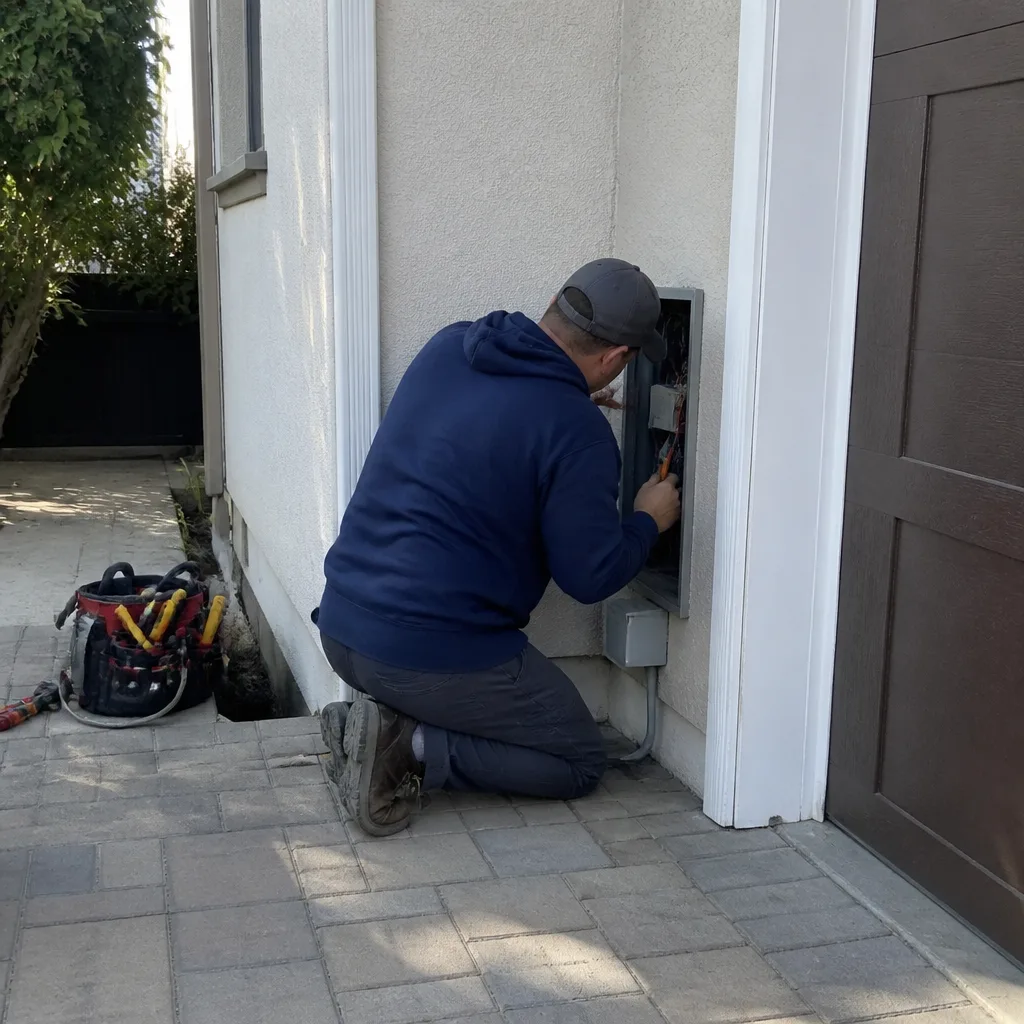
At the end of a demolition day, doorways should be zip-walled, HVAC vents taped, and debris cleared from stairways. If you visit at 5:00 p.m. and find copper pipe ends exposed, subflooring with nail plates left in place, or open electrical boxes within reach, that’s your warning. The contractor’s standard for crew safety is now visible, and it’s lower than code in Saratoga requires. The same crew who leaves a live electrical box open on Tuesday will leave a gas line unlabeled on Thursday.
Subcontractor Behavior That Reveals GC Control Problems
A general contractor in Saratoga is legally responsible for every subcontractor on your property, but legal responsibility and operational control are not the same thing. When control breaks down, you’ll need the troubleshooting steps in our General Contractor Troubleshooting guide. The difference shows up in how subs behave when the GC is not standing next to them.
Here is the pattern we tell homeowners to watch for. A plumbing sub shows up at your house on Monday morning. He walks in, sets down his tools, and asks you what he’s supposed to be doing. That tells you the GC did not send a scope letter, did not brief the sub on the project, and is likely managing the job from a distance with text messages instead of scheduled trade coordination meetings.
Even worse: a sub introduces himself as working for a different company than the one you signed with. This happens more often than homeowners realize, and it means one of two things. Either your GC is subcontracting the entire scope to another contractor without telling you, or the GC lost a sub and pulled a replacement from a labor pool without properly onboarding them. Both are control failures, and both show up later as missed details, rework, or finger-pointing when something goes wrong.
What healthy trade coordination looks like
- Each sub arrives with a printed scope sheet or has clearly reviewed plans and specifications before starting work.
- The sub knows the inspection schedule and can tell you when their trade’s rough inspection is scheduled.
- If you ask a sub who the superintendent or project manager is, they answer immediately with a name.
- No sub asks you to approve a change or sign anything without the GC present or on record.
- The same electrician, plumber, and framer show up consistently, not a rotation of unknown crews.
One of the core reasons we run all trades under a single General Contractor in Saratoga model is that trade coordination is the entire job. When every sub knows the schedule, the inspection dates, and the quality bar, the project moves. When they don’t, every week costs you money in carrying costs, temporary housing, or just the accumulated friction of a project that never feels like it’s under control.
Change Order Patterns: The Lowball-and-Escalate Playbook
The most reliable predictor of a project heading into conflict is not the first dispute. It’s the pattern of the first three change orders. On a properly scoped remodel, change orders should be rare, small, and driven by genuinely unforeseen conditions: rotted framing behind a wall the original inspection couldn’t see, or a main drain line that runs in a different direction than the as-built drawings showed.
What you should not see on a supposedly fully scoped Saratoga remodel is a change order before demolition is complete. If the contractor presents change orders for “additional structural reinforcement discovered,” “increased electrical panel capacity required,” or “additional floor leveling needed” during the first week of demo, you are likely on the lowball-and-escalate path. The contractor bid the job knowing these items would surface. They were always part of the build. The original price was a marketing document, not a construction estimate.
The three-question test for any change order
- Is the root cause visible and verifiable right now? You should be able to see the rot, the failed beam, the undersized drain yourself, or get a written report with photos from the contractor’s inspection.
- Was this condition reasonably foreseeable by someone who does this work in Saratoga every day? A contractor who has done 20 remodels in Saratoga knows what’s likely behind a 1970s stucco wall. If they act surprised, they’re performing.
- Who bears the risk contractually? In a fixed-price contract with a detailed scope, unforeseen conditions of a foreseeable type are generally the contractor’s problem. Only genuinely hidden conditions should trigger change orders.
If a change order fails all three questions, you don’t have a discovery problem. You have a bid problem, and you should push back hard. We’ve watched homeowners in Saratoga sign a third change order in week two because they’re exhausted and just want the project to move. That’s when the total cost starts climbing past what they could have paid a more expensive, more honest contractor who bid the real scope up front.
Preconstruction Communication Signals You’re About to Have a Problem
Most homeowner warning signs don’t happen on the job site at all. They happen in the preconstruction phase: the weeks between signing and the first day of demolition, when the contractor’s communication patterns reveal whether you’re a priority or a line item.
Signal one: the contractor can’t name specific products
You’re spending $40,000 on a kitchen. You ask, “What type of cabinet boxes will we use, and what’s the drawer slide hardware?” A competent contractor answers immediately: KraftMaid or Wellborn, with soft-close undermount slides at a specific grade. A contractor who says “we’ll look at that during selections” or “don’t worry, we use good stuff” is telling you they haven’t actually priced or planned your job with any specificity. Specificity is the evidence of preparation. Vague language is the evidence of a bid that was assembled from averages, and average assumptions lead to average outcomes.
Signal two: the superintendent’s name is unknown
Every decent-sized remodel has someone whose full-time job is running that project. That person’s name should be in your contract or available within days of signing. If you ask, “Who will be running my project day to day?” and the answer is “we’ll assign someone before demo,” that’s a yellow flag. If the answer is still unknown two weeks later, it’s a red flag. You are about to be managed by whatever crew happens to be available, and that’s the exact opposite of the single-point accountability you’re paying for.
Signal three: warranty questions get deflected to manufacturer documentation only
Every product in your project has a manufacturer warranty. Cambria, Silestone, and Caesarstone all publish detailed material warranties. Kohler, Grohe, and Toto warrant their fixtures differently. But a contractor who answers every warranty question with “that’s all covered by the manufacturer” is not actually answering your question. The manufacturer warrants the product. The contractor warrants the installation. If a window leaks because it was installed wrong, Therma-Tru or PGT won’t fix that. Your installer’s workmanship warranty covers it. A contractor who can’t articulate the difference between material and workmanship warranties is either avoiding the topic or doesn’t understand it well enough to explain. Neither is a good place to start a six-figure project.
During preconstruction, the Home Remodeling in Saratoga process should feel structured. You should have a schedule, a selections deadline, a communication cadence, and named contacts. If you’re three weeks from demo and none of those exist, the project is already starting behind.
Saratoga-Specific Warning Signs: Hillside Lots, Mature Trees, Seismic Retrofit
Saratoga is not Cupertino or Sunnyvale. The construction challenges here are different: hillside setbacks, expansive clay soils in some pockets, mature tree protection ordinances, and seismic conditions that affect everything from foundation design to shear wall placement. A contractor’s response to these Saratoga-specific factors tells you a great deal about whether they know the local ground they’re building on.
Hillside and drainage ignorance
Ask a contractor how they plan to manage stormwater during construction on a sloping Saratoga lot. A local contractor should talk about silt fencing, temporary drainage swales, and the city’s erosion control requirements. If they look confused, you’re talking to someone who has never managed a hillside site in Saratoga. The city will cite them, and the cost of that citation, plus the rework, will land on your project.
Tree protection plans that don’t protect trees
Saratoga has specific regulations around heritage trees and significant oaks. A contractor who has not read the city’s tree protection ordinance, or who doesn’t know which of your trees require a permit before pruning or root disturbance, is about to run afoul of the city and potentially kill a tree that adds tens of thousands to your property value. If the words “arborist report” or “tree protection zone” don’t come up during preconstruction on a treed lot, that’s a problem.
Seismic retrofit scoped as an afterthought
On a whole-home remodel in Saratoga, seismic retrofitting should be discussed during the design phase, not added when the wall is open and the building inspector notices a missing hold-down. A contractor who wants to “add a little retrofit while we’re in there” is not engineering your project. They’re improvising. Saratoga homes built before modern seismic codes need specific, calculated retrofit measures. If a contractor tells you they’ll “beef up the framing,” ask for the specific hold-down and shear panel details, the make and model of the hardware, and whether a structural engineer has reviewed the plan. Anything less is a hope, not a scope.
This is where working with a Home Renovation in Saratoga contractor who knows the local code environment pays real dividends. The same project managed by someone from outside the area will hit the same Saratoga requirements, just later, and later always costs more.
Your Homeowner Playbook: The 7 Checks Before You Sign
Here is the specific, sequential review process we’d recommend to a friend who is about to sign a contract for a Saratoga remodel. Each step takes an hour or less. Every step is a question you must be able to answer from the bid and contract in front of you.
- Verify the license and scope match. The contractor’s license number should be on the bid, and the classification should cover the work. A specialty sub license is not the same as a general contractor’s license for a whole-home remodel.
- Read the allowance schedule like a budget, not a formality. Total every allowance line item, then compare that total against a realistic local materials cost. If the gap is clear, ask for the allowance to be raised or the scope to be reduced.
- Check the payment schedule against work milestones, not calendar dates. Payments tied to “Week 1” and “Week 4” are not milestone payments. Payments tied to “after rough framing inspection passes” are. Refuse to front-load.
- Ask for the superintendent’s name and phone number in writing. It belongs in the contract. If the contractor won’t do it, that’s your answer.
- Confirm the permit plan. You want to know who pulls permits, who schedules inspections, and what happens if an inspection fails. These are contractor responsibilities, not homeowner responsibilities, on a full-scope remodel.
- Require a written change order process. The contract should state how change orders are priced, approved, and paid. No text message approvals. No verbal handshakes on scope changes.
- Verify the lien release language. The contract should state that the contractor will provide lien releases from all subs and material suppliers as each payment is made. Without this, you could pay the GC in full and still have a sub slap a mechanics lien on your house later.
If a contractor pushes back on any single one of these seven checks, that’s not a red flag by itself. Some are standard and some reflect a contractor’s own paperwork systems. But if a contractor pushes back on four of seven, or on the permit or lien release items specifically, walk away. Those are not negotiable in a project worth more than most cars.
Common Mistakes to Avoid
- Letting allowance language slide because the total bid feels competitive. In Saratoga, an unrealistically low tile or slab allowance will cost you tens of thousands once selections start. The bid that’s 10 percent lower than others often costs 15 percent more by closeout.
- Assuming the permit is the contractor’s personal guarantee of quality. The city inspects for code compliance, not for whether the tile lippage will annoy you for 20 years. Code-compliant work can still be mediocre work. Your standard has to come from your own inspection and your contractor’s reputation, not the city’s stamp.
- Paying a large deposit before demolition. Legitimate contractors have credit lines with suppliers and don’t need 50 percent up front to “buy materials.” A 10 to 20 percent deposit with milestone payments is typical for a full-scope remodel. Anything above 30 percent down is a risk transfer to you.
- Ignoring early communication problems because the work hasn’t started yet. A contractor who’s unresponsive during preconstruction will not become more responsive after you’ve signed and funded the project. Preconstruction responsiveness is your best predictor of construction-phase responsiveness.
- Skipping the lien release documentation at each payment. We’ve watched well-funded Saratoga homeowners pay $180,000 to a GC, get the project done, and then receive a demand letter from a sub three months later because the GC never paid them. Lien releases are your receipt. Require them.
- Believing a project will speed up after a slow start. If the schedule is blown in week one and nobody can explain why, the rest of the project will not magically recover. Schedules compress when someone makes tradeoffs, and the tradeoff is usually quality in the finishes you see every day.
When to Call a Professional
If you’re seeing multiple warning signs and you haven’t signed a contract yet, the best move is to pause and get a second professional opinion. A well-run contractor can review your existing bid documents and tell you within an hour whether the allowance structure, payment schedule, and scope description are sound or are built to generate change orders later. If you’ve already signed and demo has started, but you’re seeing repeated coordination failures, unannounced subs, or an unpermitted work site, you need to intervene now, not later. The cost of fixing a mismanaged project climbs with every day the wrong work continues. Viceroy Construction offers free estimates in Saratoga. Call (877) 358-6557 and we’ll walk your bid, your site, or your contract documents with you and give you an honest read on whether you’re headed toward a smooth finish or a fight. You can also browse more guides & resources on our blog.
Frequently Asked Questions
The most common early warning sign is an allowance schedule that is visibly disconnected from the stated scope, especially for tile, slab, and plumbing fixture allowances on a Saratoga remodel. A bid that pairs a high-end cabinet line with a builder-grade tile allowance is structured to generate change orders later, not to tell you the honest cost of the project. Call (877) 358-6557 if you want a second read on your bid.
Yes, you can terminate a contractor mid-project, but the process depends entirely on your contract’s termination clause and California contractor law. You’ll need a written notice, a documented list of deficiencies, and a plan for securing the job site and paying only for completed, approved work. This is the single most expensive way to finish a remodel, so the goal is to catch warning signs before you’re locked into a bad contractor. A free estimate from Viceroy Construction can help you decide whether to repair the current relationship or restart with proper management.
On a well-scoped project, change orders should total 3 to 7 percent of the contract value, driven mostly by genuinely hidden conditions. If your change orders are on pace to exceed 12 percent before demolition is complete, you’re likely in a lowball-and-escalate project structure. Ask your contractor to put every change order in writing with a specific root cause, and call (877) 358-6557 for an independent review if you’re not satisfied with the answers.
Most bathroom remodels in Saratoga require a permit if you’re moving plumbing, changing the electrical layout, altering walls, or replacing the shower pan or waterproofing system. A cosmetic refresh with fixture swaps and new finishes in the same locations often does not. Your contractor should be able to tell you definitively, in writing, before work starts. If they tell you “we don’t need permits” without explaining which work triggers the threshold, get a second opinion.
Stop work on that trade immediately and request proof of license and insurance from any sub who steps onto your property. In California, the GC is responsible for ensuring all subs are properly licensed. If your contractor won’t provide documentation, that’s a serious control failure, and you should consult a construction attorney or a reputable GC before letting any further work continue.
Ask for references from projects completed in the last 12 months, not five years ago, and ask for clients in Saratoga or neighboring cities who did a project of a similar scope and size. Then ask those references three specific questions: whether the project finished within 10 percent of the original contract, how many change orders they received, and whether they’d hire the contractor again for a project of similar size. Vague answers are answers. Call (877) 358-6557 to speak directly with our team about any of this.
The Bottom Line
Construction warning signs are not a mystery to anyone who has watched enough projects go sideways. They’re patterns: allowance-heavy bids, vague product specifications, uncoordinated subs, early change orders, and a job site that reveals more chaos than control. In Saratoga, where projects routinely cross the $150,000 mark, the cost of missing these signals starts at a bad finish and ends at a lien on your house. Learn to read the bid, the site, and the communication patterns. When something feels off, ask the question. And when you’re ready for a contractor who runs Viceroy Construction home, every trade, under one point of accountability, call (877) 358-6557 for a free estimate.
Written by the team at Viceroy Construction, serving Saratoga since 2017.
See the difference
 Before
 After
 Before
 After
 Before
 After